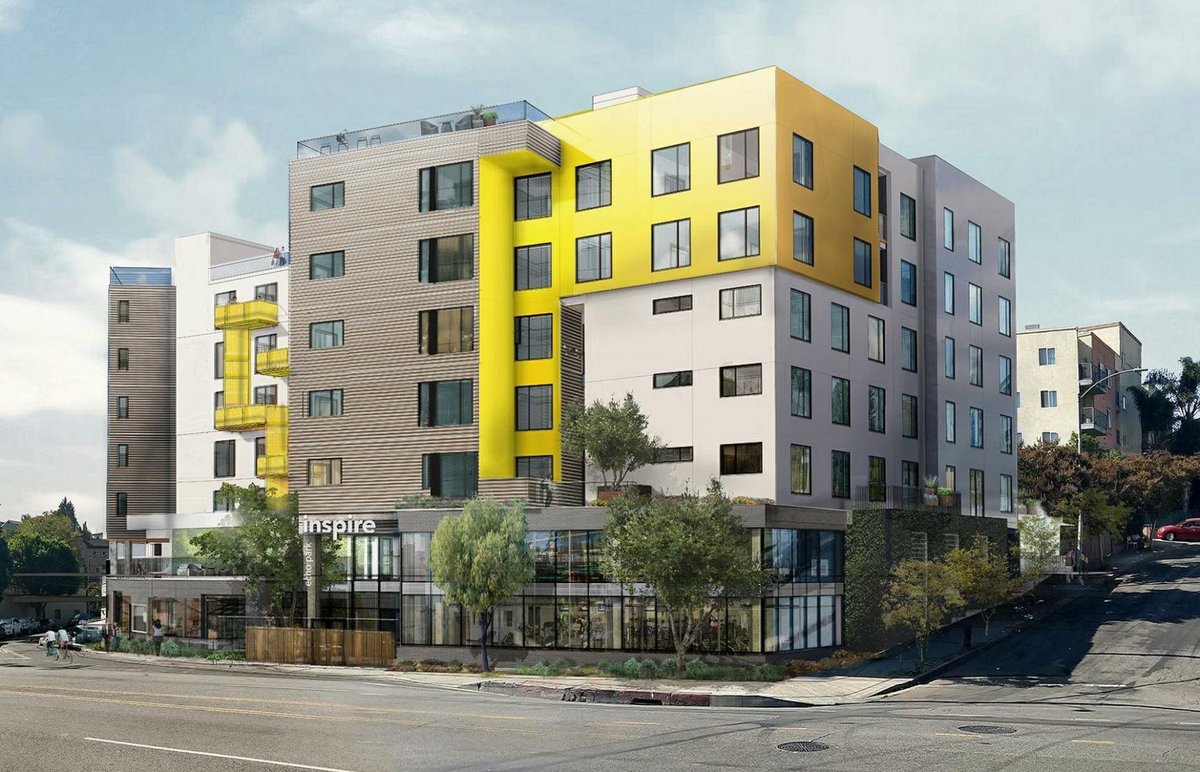
Ground-up construction is where financing gets hard. There is no income and no operating history, only a plan, a budget, and the people behind them. Getting a lender comfortable enough to fund a project that does not yet exist takes the right structure and the right story.
Piccard Financial arranged a $30,360,000 construction-to-permanent loan for the ground-up development of Inspire Echo Park, a 90-unit multifamily community at 355 Glendale Boulevard in Los Angeles. The financing was placed with a regional bank and built to fund construction, then convert to long-term permanent debt once the property stabilized.
The project
Inspire Echo Park is a 90-unit building with a mix of studio, one-, two-, and three-bedroom apartments, designed by HED as a contemporary podium structure with a resident lounge, fitness center, pool, and rooftop deck. The site was entitled under the City of Los Angeles Transit Oriented Communities program, which grants additional density beyond base zoning in exchange for an affordability commitment. Here, that meant setting aside ten apartments as affordable housing at the very low-income level. The trade produced a larger, more efficient project on a well-located, transit-adjacent parcel, which is exactly the kind of profile a construction lender wants to underwrite.
Why the sponsor carried the deal
On ground-up construction, lenders underwrite the sponsor as heavily as the asset, because the loan funds a promise to build. The developer here, Bond Companies, brought the track record a construction lender looks for. Founded in 1987 by Larry and Robert Bond, with offices in Los Angeles and Chicago, the firm has been named Residential Developer of the Year by the Los Angeles Business Journal and has delivered award-winning mixed-use projects across the country, including the landmark Sunset & Vine development in Hollywood. A sponsor with completed, comparable projects and the balance sheet to stand behind a build gives a lender confidence that the plan becomes a building.
On a ground-up deal, the lender is not financing a building. It is financing a plan, a budget, and the people behind them.
How the financing was structured
We structured the loan as construction-to-permanent: a single facility that funds the build and then converts to long-term financing once the project is complete and leased. During construction, the loan is interest-only and draws down as costs are incurred. On stabilization, it rolls into a permanent loan without a second closing.
That structure solves the problem sitting at the center of every ground-up deal: takeout risk. A standalone construction loan has to be refinanced when the building is finished, and if the debt markets have moved against you by then, that refinance can be expensive or simply unavailable. Locking the permanent takeout at the construction close removes the uncertainty. The sponsor knows, on day one, what the long-term financing looks like.
The loan was sized to the lesser of loan-to-cost and a debt-service coverage test on the permanent takeout. The bank funded up to 70% of total project cost, with the permanent loan sized to a 1.15x debt-service coverage ratio on stabilized income. In plain terms: the lender advances against the cost to build, but caps the permanent balance at a level the finished, leased building can comfortably carry.
One term worth calling out is the recourse structure. Construction loans usually carry full repayment guaranties from the sponsors, because the lender is funding an unbuilt asset. We negotiated a burn-off: the guaranty steps down as the project hits defined milestones, completion, lease-up, and a target coverage ratio, and ultimately burns off to a limited position once the building performs. For a sponsor, that materially reduces personal exposure over the life of the loan, and it is one of the more valuable points an advisor can win in a construction term sheet.
Pricing was locked in at a favorable point in the rate cycle, with the construction loan priced over SOFR and the permanent conversion offering a competitive long-term rate. Timing a construction close to the rate environment is part of the work; a few months in either direction can move the economics of a ten-year hold.
What makes construction financing work
Ground-up financing rewards preparation. The deals that get funded, and funded on good terms, tend to share the same handful of traits:
- A credible sponsor with completed, comparable projects and the liquidity to guarantee the build.
- A fully-costed budget, with hard costs, soft costs, contingency, and a realistic construction schedule.
- Site control and entitlements in hand, so the lender is financing execution rather than entitlement risk.
- A defensible takeout, whether a permanent loan locked at close or a clear sale or refinance plan on stabilization.
- Leverage sized to cost and coverage, so the finished building can service its own debt.
Miss any of these and the deal either does not get funded or gets funded at a price that erodes the return. Getting them right, and packaging them so a credit committee can say yes, is where an advisor earns the fee.
Project and sponsor details reflect public record. Terms described are specific to this transaction and are not an offer or a commitment to lend.