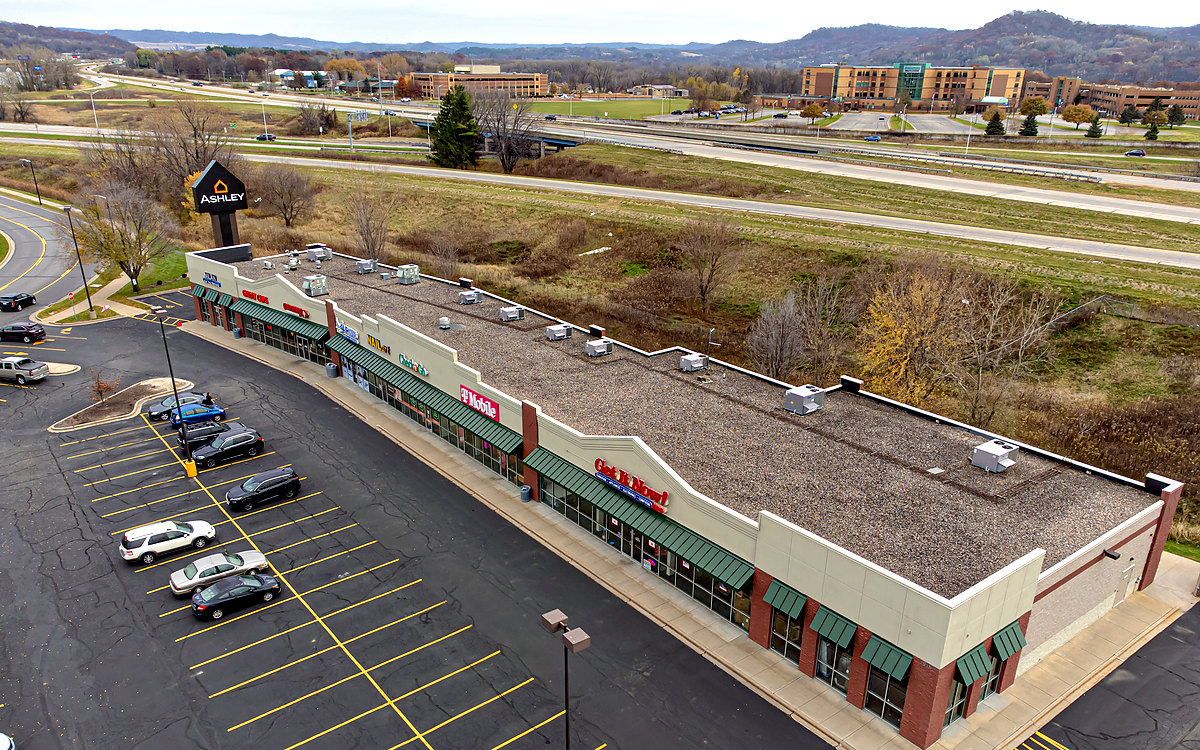
Strip center loans are easier to get in 2026 than most owners expect. Banks and CMBS lenders are actively financing neighborhood and strip retail, and the stress in retail credit data comes mostly from malls. The Mortgage Bankers Association reported a 61% year-over-year rise in retail loan volume in the second quarter, and Cushman & Wakefield put national shopping center vacancy at 5.9% in the third quarter. The harder part is the rent roll. With the 10-year Treasury at 5.13%, coverage sets the loan amount, and lenders are underwriting each lease that ends during the loan term.
Where strip center financing stands, with dates
- Vacancy is low and flat. Cushman & Wakefield's third-quarter report, covering community, neighborhood, power and strip centers, held national vacancy at 5.9%, against a 7.4% historical average. Net absorption was 3.5 million square feet, and asking rents were up 2.2% from a year earlier, to $25.82 a foot. Colliers, using CoStar data, measured shopping center vacancy at 5.4%. The two inventories differ, but both point the same way.
- Little new supply. Only 2.3 million square feet was delivered in the third quarter, and the pipeline is 0.4% of existing inventory. The exception is the South, the only region where vacancy rose, "reflecting new supply, particularly in strip centers."
- Lending is up. In the MBA's second-quarter index, retail loan volume rose 61% year over year. By lender type, CMBS rose 68% and banks and other depositories 61%, while life company lending fell 27%.
- Retail credit improved, malls aside. Trepp's retail CMBS delinquency rate fell 62 basis points to 6.58% in September, "on the mall cures," even as the overall rate rose to 8.02%. Retail special servicing rose to 13.84%, driven by large mall and shopping center transfers.
- Pricing. Northmarq, citing Real Capital Analytics, put the average multi-tenant retail cap rate at 7.08% in the second quarter, from 6.27% in the West to 7.87% in the Midwest. Green Street reported strip center cap rates about 15 basis points lower in the first quarter.
- Rates. On October 21 the 10-year Treasury closed at 5.13% and the 5-year at 4.95%. SOFR was 3.88% on October 20, and prime is 7.00%.
Who lends on strip centers, and on which ones
Banks and credit unions: stabilized local centers. For a center under about $15MM with a granular tenant mix, a bank or credit union is usually the first call. Our $4.35MM non-recourse bank loan on an anchored center in Banning, California closed in May 2025 at 5.62% fixed. The 10-year ran from 4.25% to 4.58% that month, so the spread was about 104 to 137 basis points. Add that spread to today's 5.13% and you get about 6.2% to 6.5%. That is arithmetic, not a quote. CBRE's second-quarter average commercial spread of 204 basis points, on the 5-year or 10-year, gives about 7.0% to 7.2% for a more typical center.
CMBS: larger centers, and higher leverage on strong ones. Conduit lenders are back on grocery-anchored and well-leased neighborhood retail. They size to debt yield first and need clean third-party reports. Expect defeasance or yield maintenance, so check prepayment before you price.
Debt funds: vacancy, lease-up and speed. When an anchor has left, a big lease is rolling or a maturity arrives early, a floating-rate bridge sized to the stabilized center is the tool. Our retail and office bridge at 8560 Wilshire closed at 8.00% in March 2026, when SOFR ran 3.62% to 3.71%. At the same spread it would price at about 8.2% today. Our Yucca Valley retail bridge closed in seven business days. More is on our bridge loans page.
Life companies: low leverage, top centers. They are pulling back this year. When they quote, it is usually for grocery-anchored centers at modest leverage.
The address gets the meeting. The tenants and their lease dates set the loan.
How lenders underwrite a strip center now
Tenant mix and category. Lenders sort tenants by what is still opening stores. Cushman counts 1,046 discount store openings and 214 off-price apparel openings so far this year. It expects centers anchored by those categories to be "better protected from cyclical disruption." Daily needs, service and food tenants count as durable. Pharmacies, bank branches and apparel boutiques get closer review, because those are the categories closing stores.
Rollover inside the term. Expect the lender to list every lease that ends before maturity and model downtime, free rent and re-leasing costs for the larger ones. Tenant improvement and leasing commission reserves are sized from that list, not waived.
Anchor terms. Lenders read co-tenancy and go-dark clauses. They want to know whether an anchor owns its pad or is a shadow anchor on another parcel. A shadow anchor still brings shoppers, but the lender cannot underwrite its rent.
Coverage and debt yield. CBRE's second-quarter averages across all commercial loans were 59.6% loan-to-value, 1.43x coverage and a 10.2% debt yield. On strip centers, in the quotes we see, banks look for about 1.25x on in-place income, and that test usually binds before value does. See debt yield explained for how the second test works.
A refinance, sized, and the tenant that changes it
Take an illustrative 30,000 square foot neighborhood strip in a Western metro with $720,000 of net operating income. At the 6.27% average Western cap rate, it is worth about $11.5MM.
The three tests. At 65% loan-to-value, value supports about $7.46MM. At an assumed 6.50% rate, 25-year amortization and 1.25x coverage, income supports about $7.11MM. A 10% debt yield supports $7.2MM. The lender takes the lowest, so coverage sets the loan at about $7.1MM.
The tenant. Now say a 4,000 square foot drugstore paying $24 a foot, $96,000 a year, has a lease that ends 18 months after closing with no renewal signed. A cautious lender underwrites that income out. Net operating income becomes $624,000, and the same coverage test supports about $6.16MM, roughly $950,000 less.
The fixes. Get the renewal or a replacement lease signed before you apply. Or offer a holdback or a reserve that the lender releases on performance. Our $22MM Lincoln Road refinance closed with a six-month payment reserve for that reason. Or bridge the gap and refinance once the lease is done. Run the numbers both ways before you call a lender.
What strip center owners should do this quarter
- Build the lender's rent roll yourself. Every lease, its end date and options, plus sales and rent-to-sales ratios where you have them.
- Flag the categories lenders flag. Pharmacies, bank branches, apparel and any tenant over about 15% of income. Know your answer for each before the lender asks.
- Size coverage at today's rates. With the 10-year at 5.13%, a loan written in 2021 or 2022 may not refinance at the same balance. Our maturity playbook sets out the timeline.
- Price the prepayment. Defeasance, yield maintenance or a step-down can matter more than ten basis points of rate.
- Start early. Third-party reports, tenant estoppels and a clean rent roll take the most time. Begin six to nine months before a maturity.
Quick answers
Can you get a loan on a strip mall in 2026? Yes. Banks, credit unions and CMBS lenders are financing stabilized strip and neighborhood centers, and retail loan volume rose 61% year over year in the second quarter. Centers with heavy near-term rollover or a dark anchor usually start with a bridge.
What are strip center loan rates right now? As arithmetic on today's base rates, not quotes: about 6.2% to 7.2% fixed for stabilized bank and conduit loans with the 10-year at 5.13%, and about 8.2% and up for floating-rate bridge loans with SOFR at 3.88%.
How much leverage can a strip center get? Typically 60% to 65% of value from banks, limited first by about 1.25x coverage at today's rates. CMBS can stretch on strong centers but sizes to debt yield.
Is an unanchored strip center harder to finance than a grocery-anchored one? Somewhat. Lenders want more granular tenants and shorter rollover, and fewer life companies will quote. A well-leased unanchored strip with daily needs tenants still finances with banks and conduits.
If you own a strip or neighborhood center with a maturity, a vacancy or an acquisition ahead, send us the rent roll and the numbers. We will tell you within two business days which capital fits the center and what it will take. More on our approach is on the retail financing page, and this week's rates are in the Capital Markets Update.
Sources. Shopping center vacancy, absorption, rents, deliveries and store openings: Cushman & Wakefield U.S. Shopping Center MarketBeat Q3 2026, October 14, 2026. Shopping center vacancy, second measure: Colliers and CoStar via CRE Daily, October 13, 2026. Originations: Mortgage Bankers Association, August 6, 2026. CMBS delinquency: Trepp, October 2, 2026. Special servicing: Trepp, October 13, 2026, and Connect CRE, September 17, 2026. Cap rates: Northmarq Multi-Tenant Retail MarketSnapshot Q2 2026 (Real Capital Analytics data); Green Street via CRE Daily, July 19, 2026. Spreads, leverage, coverage and debt yield: CBRE Lending Momentum via MBA Newslink, August 5, 2026. Treasury yields: U.S. Treasury daily par yield curve, October 21, 2026, and May 2025. SOFR: Federal Reserve Bank of New York, October 20, 2026, and March 2026. Prime: Federal Reserve H.15, released October 21, 2026. Spreads implied by Piccard closings are computed from each closing's note rate and the benchmark's range in its closing month. The loan sizing example is illustrative.
Rates and terms referenced are drawn from public market data, transactions arranged by Piccard Financial and recent lender quotes, reflect conditions on the dates shown, and change with the market. Nothing here is an offer or a commitment to lend. Piccard Financial is a capital markets advisory firm, not a lender.